Securing Funding: The role of philanthropy in scale

Looking at philanthropy as a sustainable funding source and the way funders can support non-profits.

Insights on:
LeadershipStrategy
Alice Foster-Metcalf
Senior Manager
November 21, 2024
Share Post

As part of our series on funding, using lessons from 28 non-profit leaders on the roles and trade-offs of different funding types, this week we’ll be diving into a ‘hot topic’, philanthropy.

A major pillar of non-profit funding, we often debate how sustainable philanthropy is as an income source. Some argue that non-profits must find funding models with enough income generation to sustain the model, whilst others argue that philanthropy is actually the most sustainable source as it is the least volatile to things such as economic crises.

Whether sustainable or not, our study showed how philanthropy remains a lifeline for most non-profits, including those scaling at impressive levels. Philanthropic funding makes up 68% of the funding of the 28 non-profits in our report.
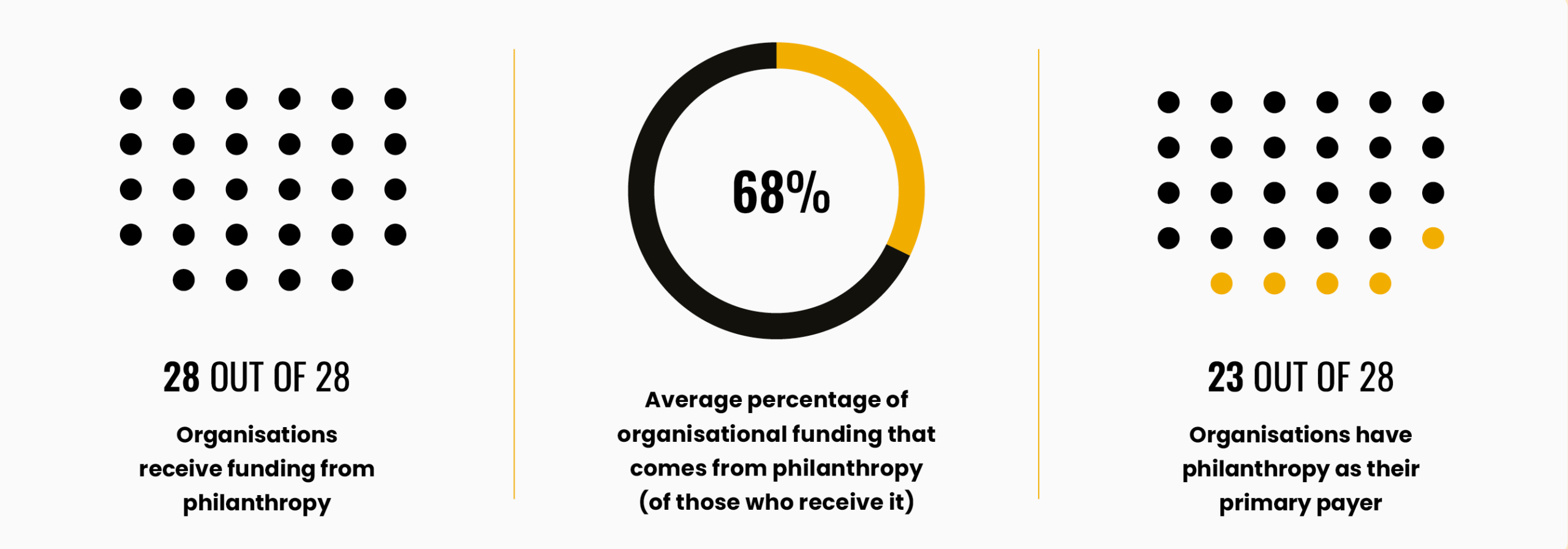
Many philanthropic funders often expect their grantees to eventually find other major backers, but in reality non-profits normally require ongoing philanthropic support to sustain impact at scale.

Even when they find other ‘doers’, non-profits almost always have to provide ongoing support to ensure those solutions scale successfully. Non-profits need to fundraise for this, and most of that funding is coming from philanthropic funders.


What does this mean for non-profits? 

  • Be realistic. Creating a full ‘sustainable’ model that does not rely on philanthropy, takes a long time and requires a long runway.
  • Communicate to funders the critical roles that you need to play to get the solution to scale.
  • Prove cost-effectiveness. Learn what price point payers are willing to pay. Demonstrate your solution can be delivered affordably within that price point, which often requires a low cost per outcome.
  • Build evidence of impact. Convince payers your solution is the best return on investment and more effective than others, using randomised control trials (RCTs) as evidence.

Whilst these are some things we can do to increase our chances of accessing philanthropic funding, the reality is that funders hold most of the power to shift the system to enable better funding for scale.


What does this mean for philanthropic funders? 

  • Long-term investment and flexible funding is key to getting return on investment. By investing long-term in ecosystem enablers – non-profits who have gotten others to deliver their solution at scale and need to provide ongoing support – funders are more likely to hit the ‘impact jackpot’ and get a higher return on investment.
  • Sustained impact at scale is rarely achievable without multi-year commitments from funders that provide sustained support to ensure that non-profits can continue to grow and adapt without facing funding gaps.
  • Philanthropy is important at every stage of a non-profit’s journey to scale, not just in the early stages of solutions development and piloting.
Press enter to search or esc to cancel